
Company
Introducing PlasmoLAB: the workspace for reusable experimental knowledge
Meet PlasmoLAB, an AI-native workspace connecting DNA/RNA design, lab notes, analysis, and decisions.
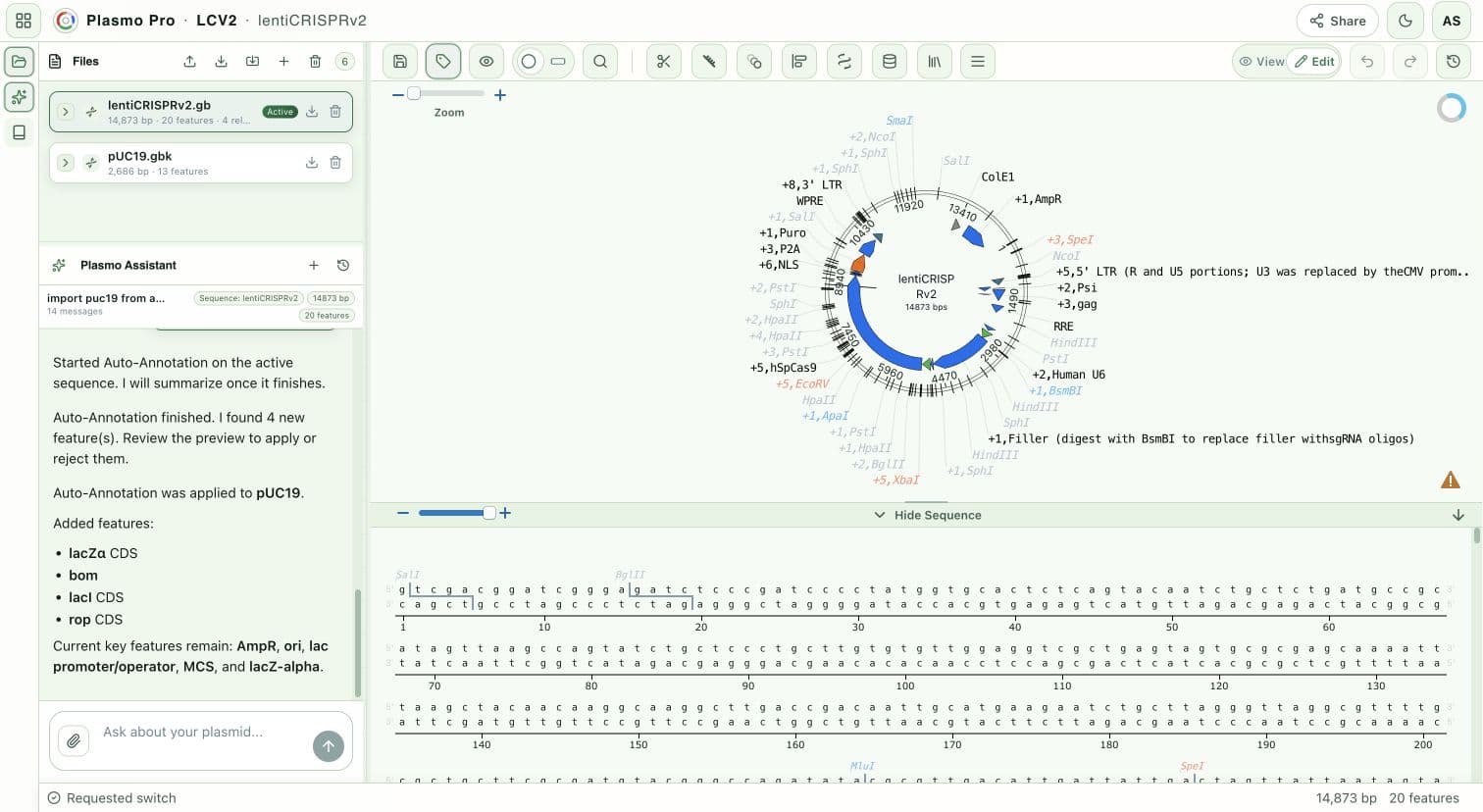
When a molecular biologist revisits an old project, they rarely begin with the science. They begin with understanding the timeline.
The construct is in one application. The protocol is in a document copied from another experiment. A plate photo is on someone's phone. The analysis is in a notebook named final_v3_revised The most important decision is why one design moved forward and three others did not. It survives only in a Slack thread or in the memory of the person who made it.
We know this workflow because we lived it.
PlasmoLAB is the team building Plasmo, an AI-native workspace for molecular biology. We started this project around a simple belief: the work of biological engineering should become more valuable every time an experiment is run, not harder to reconstruct.
Research rarely remembers the failed branches
Modern molecular biology has extraordinary specialist tools. We can design complex constructs, order DNA in days, run high-throughput assays, and analyze more data than a lab could have imagined a generation ago.
But the connective tissue between those steps is still surprisingly manual.
A sequence editor knows the bases, but misses the hypothesis. A lab notebook records what happened, but may not know which exact sequence version went to the bench. An analysis environment produces a figure, but not always the design decision that figure changed. Cloud folders store all of it without understanding how any of it relates.
The result is a broken loop:
Design → Experiment → Data → Learning
The steps happen. The loop rarely closes.
We feel this is more than a documentation problem. It changes how teams make decisions. When context is scattered, review takes longer, handoffs become lossy, and the next experiment starts with a partial memory of the last one.
The unit of work in biology is rarely a file. It is more of a decision connected to a design, an execution, an observation, and what came next.
A workspace around the whole experiment
Plasmo is our attempt to give that unit of work a home.
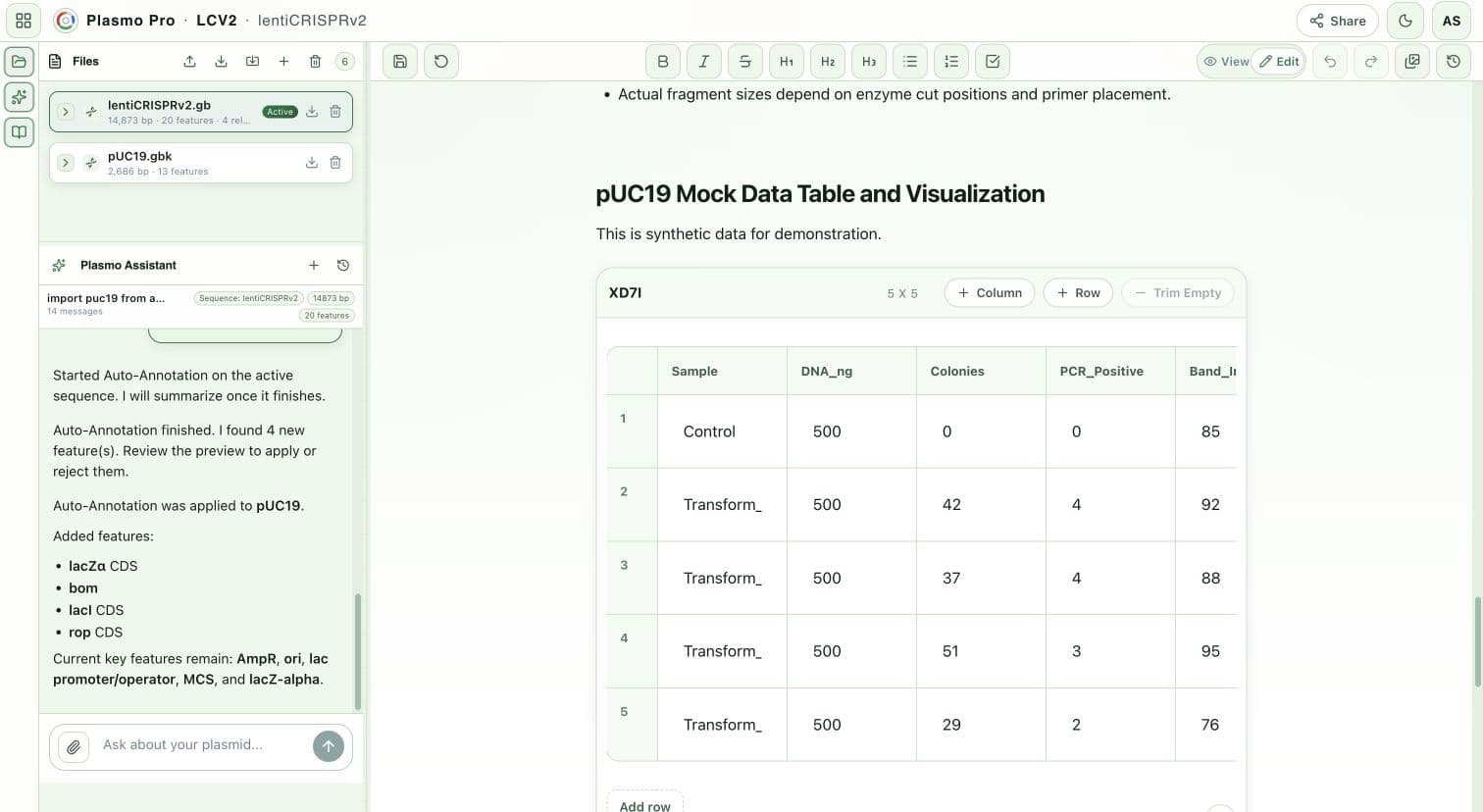
In a Plasmo project, the sequence, notebook, supporting files, analysis, collaborators, and AI assistant share the same context. The goal is to remove the seams researchers currently have to manage by hand.
That changes the shape of everyday work:
- A design decision can live beside the sequence version it produced.
- A protocol can reference the construct it is meant to test.
- Sequences, annotations, and similarity-search results can be pulled directly from trusted sources such as NCBI, Addgene, UniProt, and BLAST without breaking project context.
- A spreadsheet or Python result can stay with the observation it explains.
- An AI suggestion can be reviewed against the actual project, then accepted or rejected explicitly.
- A teammate joining later can follow the reasoning without asking someone to retell the entire story.
Today, Plasmo brings a browser-based DNA/RNA design surface together with a collaborative scientific notebook. Teams can work with familiar GenBank and FASTA files, reliably retrieve sequences and annotations from NCBI, and UniProt, run BLAST searches, plan and inspect cloning workflows, perform sequence analyses, write rich notes, use spreadsheets and in-browser Python, attach project images, and keep a traceable history of accepted changes.
The platform is broad because the experiment is broad. But the principle underneath it is narrow: context should travel with the work.
AI should work with scientists, not around them
AI is already changing how scientific software is built. It can help compare design options, draft a protocol, inspect a sequence, summarize results, or turn a rough bench note into something structured.
The hard part is making generated answers that are trustworthy enough to use.
For us, that means AI has to be grounded in the current project, clear about what it is doing, and subordinate to scientific judgment. In Plasmo, sequence-changing actions can be presented as proposed edits for review. Tool results remain visible. Accepted changes are part of project history. The scientist stays in control of the transition from suggestion to record.
The future of biology does not have to look like a mysterious agent silently operating the lab. We think it looks like researchers spending less time assembling context and more time applying judgment.
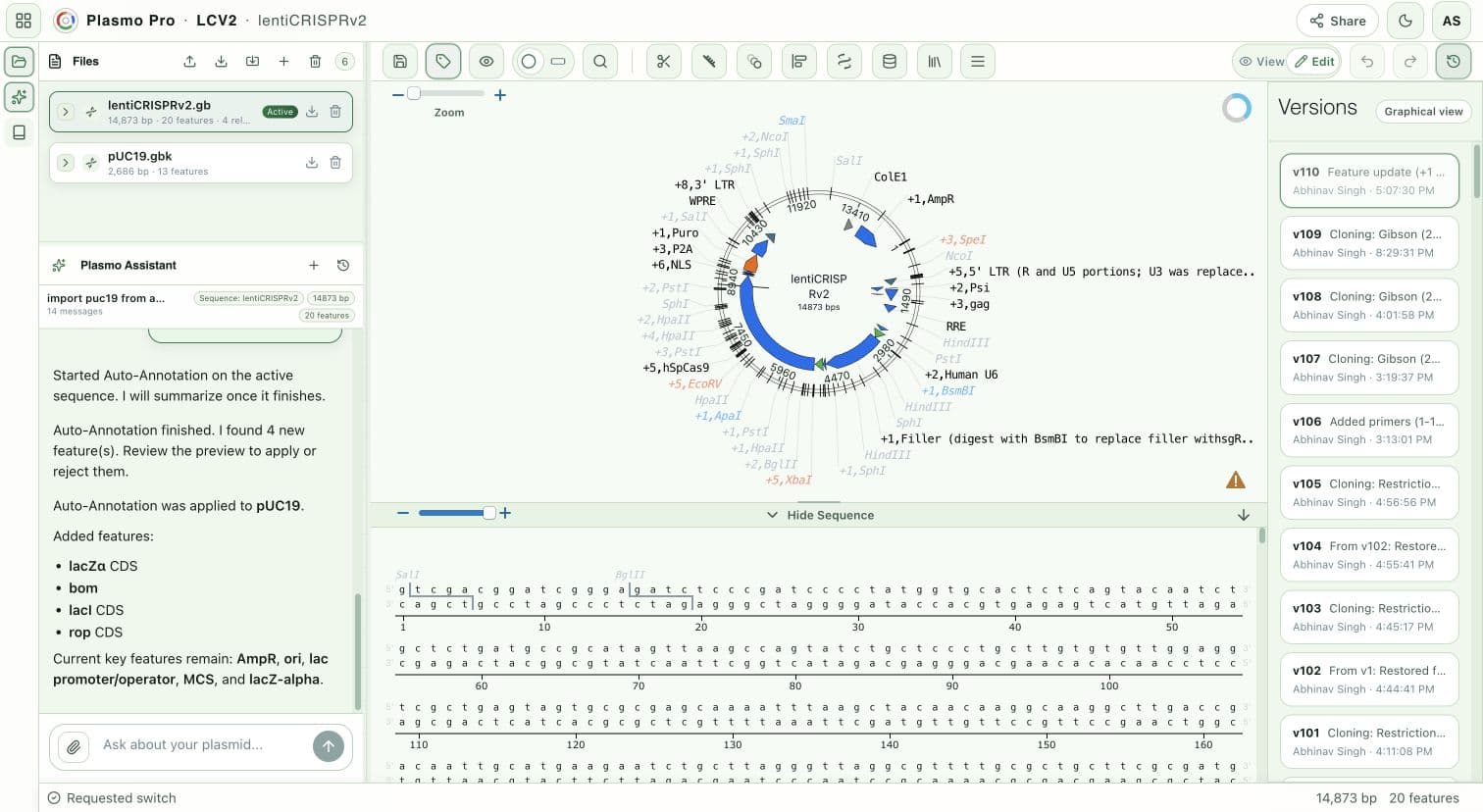
DNA and RNA design is technically demanding and rich in context. A construct carries biological intent, design tradeoffs, sequence features, assembly choices, primers, validation plans, and a chain of revisions. Once that construct moves to the bench, it accumulates protocols, sample metadata, images, assay data, analyses, and decisions.
Connecting that path creates immediate value. It also creates the foundation for something larger: a structured record of how a team designs, tests, and learns.
We are building first for the teams that feel this fragmentation most sharply. They work in academic labs and biotech companies across gene therapy, RNA therapeutics, synthetic biology, and adjacent areas of molecular biology.
Built from both sides of the bench
PlasmoLAB is being developed by a collaboration between a bioengineer and a computational scientist.
We are building the platform we wished we had while doing biological research. That sentence is personal, but it is also a platform constraint. Plasmo has to respect the way researchers actually work. It has to open existing files. It has to be useful before a lab has perfectly structured data. It has to support the messy middle of an experiment, not only the polished record at the end. And it has to earn trust through visibility and control.
What we want Plasmo to become
Our ambition is a workspace where experimental knowledge compounds.
Knowledge compounds when the evidence, reasoning, and outcome of one experiment are easy for the team to find and reuse in the next.
Over time, a project should answer more than “what files do we have?” It should answer:
- What were we trying to learn?
- Which design did we test, and why?
- What changed at the bench?
- What evidence did we collect?
- How did that evidence change our next decision?
That is the full loop. It is also the standard we will use to decide what belongs in Plasmo.
We are early, and we are building in the open with scientists who care about better research infrastructure. If this problem feels familiar, try Plasmo, or tell us about the workflow your team is still holding together by hand at info@plasmolab.com.
A useful scientific workspace will make the work researchers are already doing easier to understand, safer to hand off, and more useful the second time around.